Mozambique Media Compass: Discover the Real Audience Map Before Planning Your Next Campaign
RESEARCH & MARKET
Mozambique Media Compass: Discover the Real Audience Map Before Planning Your Next Campaign
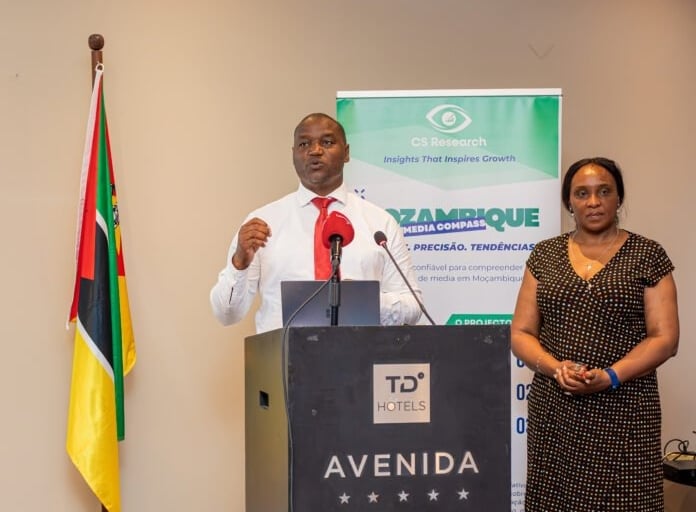
The Mozambique Media Compass, launched this Thursday at Hotel Avenida in Maputo, reveals that 13.5 million Mozambicans — 72% of the adult population — consume digital media, surpassing television for the first time. Print media reaches only 6%, while outdoor advertising records the highest attention rate among all media, at 92%.
CS Research presented in Maputo the first results of the Mozambique Media Compass, a national multiplatform audience measurement study described by the market research company as the first independent and continuous “market currency” for the media and advertising industry in Mozambique. The event, which brought together representatives from advertisers, advertising agencies, television and radio operators, digital platforms, financial institutions, and development partners, marks the end of an era in which media planning in Mozambique relied on estimates and perceptions, and the beginning of a culture of decision-making based on verifiable data.
The Media Hierarchy Rewritten: Digital at the Top
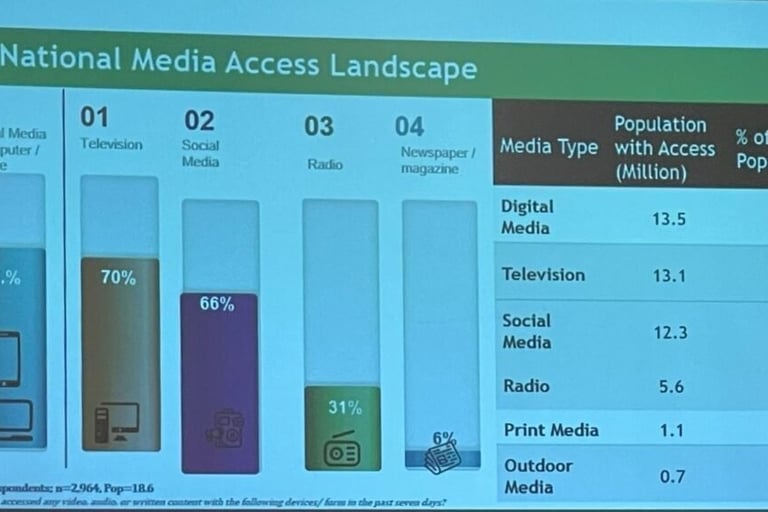
The most structural and disruptive finding revealed by the Mozambique Media Compass is that digital media are, for the first time in a nationally representative and documented way, the most widely consumed medium in Mozambique.Based on a sample of 2,964 respondents representative of a population of 18.6 million adults, the study shows that 13.5 million Mozambicans — 72% of the population aged 15 and above — accessed video, audio, or written content through digital devices (computers or mobile phones) in the seven days prior to the interview.
Television, which for decades was the dominant medium in Mozambique’s advertising market, ranks second with 13.1 million viewers, representing 70% penetration — just two percentage points below digital.
Social media ranks third with 12.3 million active users (66%), confirming the convergence between digital penetration and the widespread adoption of platforms such as Facebook, WhatsApp, and TikTok in the country.
Radio, historically dominant in the African context due to its geographic reach and accessibility in rural areas, shows a penetration rate of 31%, equivalent to 5.6 million listeners. This reflects the impact of the digital transition, while maintaining radio as an irreplaceable medium in contexts with limited access to electricity and internet.Print media, with 1.1 million readers and only 6% penetration, and outdoor media, with 0.7 million users and 3.8%, complete the hierarchy.
The Biggest Surprise: Who Really Pays Attention to Advertising
While access data rewrites the media hierarchy, attention data introduces a second disruption — equally important for brand communication strategies.
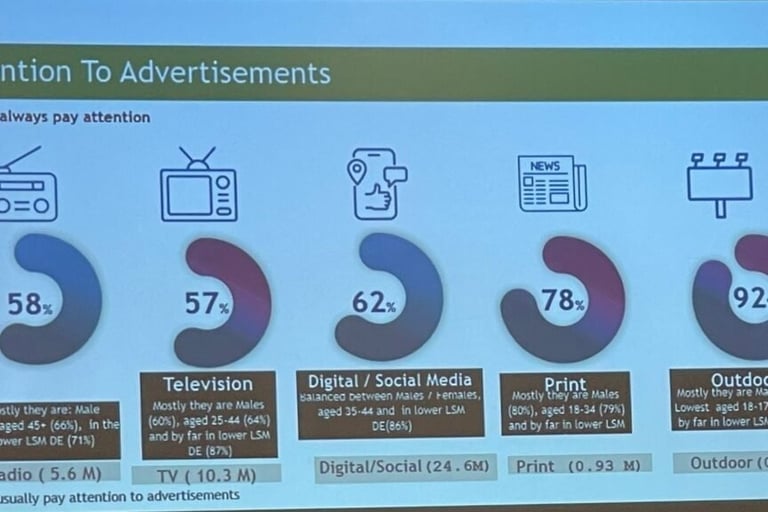
Contrary to industry intuition, which tends to prioritize television and digital as the most effective advertising channels, the study reveals that outdoor advertising records the highest attention rate of all media: 92% of its audience report always paying attention to the ads they see.
This audience is predominantly male (92%), with strong representation among the 18–27 age group (68%) and heavily concentrated in lower socioeconomic segments (LSM DE: 98%).
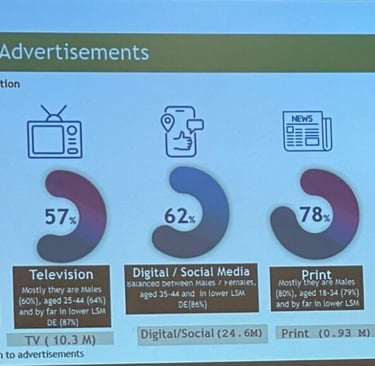
Print media ranks second with a 78% attention rate — a remarkable result for a medium with only 6% penetration. Its readers are highly engaged, mostly male (80%), aged 18–34 (79%).
Digital and social media record 62% attention, with a gender-balanced audience profile, concentrated among 35–44-year-olds and strongly represented in lower socioeconomic segments (LSM DE: 86%).
Radio and television show the lowest advertising attention rates — 58% and 57% respectively. While this does not diminish their reach, it suggests a more passive, multitasking consumption environment.
Seven Audience Profiles: From Social-Only to Omnichannel
One of the most innovative aspects of the Mozambique Media Compass is its analysis of media convergence, identifying seven distinct audience profiles with direct implications for campaign planning.
The dominant group consists of consumers who combine television and social media (TV & Social), representing 35.6% of the total audience. They are described as the “dominant hybrid group; household decision-makers,” primarily female, aged 25–34, and belonging to the C1 segment.
The second most relevant group is Social-Only (15.8%): urban youth living entirely within the mobile ecosystem and “virtually unreachable through traditional advertising.” Their profile is mainly male, aged 18–24, in the C1 segment. This group represents a critical frontier for advertisers still focused on traditional media.
The TV-Only group accounts for 16.8% of the audience — “traditionalists; rural communities consuming passive, linear broadcast content,” primarily female, aged 25–34, in segment C2.
Radio-Only represents 9.9%, predominantly female and strongly concentrated in segment C2 (77%).
Omnichannel consumers — those using radio, television, and social media simultaneously — represent 11.3%, mainly male, aged 25–34, in segment C1.
Consumers combining radio and TV account for 6.4%, while those combining radio and social media represent just 3.1%.
The Methodology Behind the Credibility
The robustness of the data is based on a methodology designed to overcome the limitations of previous audience studies in Mozambique.
The Mozambique Media Compass conducts 1,100 monthly face-to-face interviews, covering all provinces in both urban and rural areas, conducted in local languages and based on national census sampling. The target population includes individuals aged 15 and above.
Data is adjusted using RIM (Raking / Iterative Multivariate Weighting), aligning the sample with national population parameters by age, gender, and geographic region, ensuring strong statistical representativeness.
The database is cumulative and dynamic, with quarterly and annual trend analysis that will, over time, document shifts in audience behavior and emerging media consumption trends.
What This Means for the Market
The launch of the Mozambique Media Compass comes at a time when Mozambique’s advertising market faces increasing pressure to justify communication investments with verifiable data.
National and international advertisers — from telecommunications companies to financial institutions, consumer goods manufacturers, and government bodies — have operated for years with fragmented, partial, and non-comparable information across media.
The finding that digital now surpasses television in penetration, while outdoor and print significantly outperform digital in advertising attention, is in itself a result that demands a deep reassessment of advertising budget allocation models in the country.
The convergence between media, highlighted by the seven audience profiles, confirms that single-channel strategies are increasingly inadequate in a market where more than one-third of the population consumes both television and social media simultaneously.(Simão Djedje)